Looking for an easy digestible explanation what considerations to make for Mid-Year Enrollments under a Section 125 plan? Check out this great video from colleague, Chelsea Whalley of J Donovan Financial.
Special Mid-Year Enrollment Window
1. Get Approval from Health Insurer in writing. If Self-funded, approval comes from stop-loss carrier.
2. Decide if these special deductions will be pre-tax or post-tax. As of right now, the IRS has issued no guidance for pre-tax elections due to COVID-19.
Section 125 Mid Year Election Change Events:
1. Change in employment status if the change impacts eligibility for health plan
2. A significant change in health plan coverage
3. HIPAA Special Enrollment (marriage, birth, etc)
To avoid any unintended liability, employers should check with your CPA and/or attorney to decide what is best for your business.
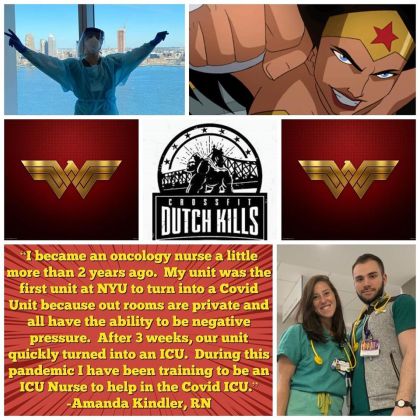
This week’s #WonderWomanWednesday is someone near and dear to us in NYC. Amanda Kindler was a Registered Nurse working in Oncology prior to the Covid-19 Pandemic and was part of the first Covid Unit in the NYU Hospital System. When Amanda has some downtime, which is rare, she’s sure to log in her CrossFit workout from the CrossFit Dutch Kills box in Queens, NY where she has been a member for about 2 years. We salute Amanda and all the other healthcare providers putting themselves at risk during this time to help the people of our city!
We know New Yorkers are resilient and are ready to push up their sleeves and help their community during times of struggle, however we are in uncharged waters. If you are looking for ways to help out during this time, the Capalino+Company team has published an excellent list to show creative ways you can help during this time! Stay Safe!
Here are ways for New Yorkers can help during this crisis:
Share the mission of Invisible Hands to provide safe, free food deliveries for NYC’s most at-risk communities facing COVID-19
Sign up for alerts from New York Cares to learn more about what city agencies and community partners are doing to help those most impacted by COVID-19
Donate to the WHYHunger Rapid Response Fund to protect food access for all people by bolstering WHY’s work with emergency food providers, small-scale farmers, and food chain workers
Secure masks, gloves, and hand sanitizer for police officers on patrol across the city through the New York City Police Foundation
Broaden your reach by contributing to The New York Community Trust NYC COVID-19 Response & Impact Fund to aid nonprofit service providers struggling with the health and economic effects of the coronavirus; the fund will give grants and loans to NYC-based nonprofits that are trying to meet the new and urgent needs that are hitting the city
Help the Robin Hood Foundation raise funds to put together a food program for their network of nonprofits to continue to serve low-income communities
Hello from the Covid-19 epicenter, aka NYC. I don’t know about you all, but the past few weeks have been crazy, exhausting and just plain sad at times. It is definitely not business as usual here and I know that’s true in many other places as well, but I also know we will all make it through this time. One of the things that has kept me going during quarantine is connecting with the incredible women from our industry who are still able to share some great ideas with me about what they are most proud of in the last 12 months. Be on the lookout for another article coming soon that will include many of the featured women in this series who will share what they have been doing to stay connected with their clients during all of this.
This month, I’m going to introduce you to two new friends who have been a great source of information and support for me during this time. I know I have said it before, but it is so important to develop these peer-to-peer mentorship relationships, because when there are rough times like these, we pull each other up and help each other to excel. Please join me in welcoming Chelsea and Jennifer to the fold.
“In the past 12 months, my biggest accomplishment has been learning that my business is not actually about me.
When I owned my first agency, I was infatuated with the idea of developing other agents. While this sounds admirable, I was truly motivated by the energy rush I received seeing others succeed. Even though I was helping others, at the core of it all, it was still about me.
Even in my second agency, there have been times when I put together the best options for a prospect to save them money and time; yet, I still don’t win. When this would happen, I would make it about me (my presentation skills, my sales skills, etc). Perhaps it was, but there’s a good chance that it was about one of the million other factors that business owners consider when making decisions.
The truth, and my biggest lesson, is that nothing is about me. I have learned that the only way to truly scale my business and help as many employees and clients as possible is to let go of the belief that the outcome is directly tied to my worth as an advisor or as a person. With this, I can finally be present and enjoy the work I am doing.”
“I’ve been in financial services many years and I’ve never been more excited to do what I do. My passion lies in supporting women and giving back. In my role, training and developing agents to build their business, I’m able to do both. I’ve seen great success among the women leaders who count for almost half of my business. In the last year, I’m pleased to have been highest-producing field leader at my company, hitting record sales. And helping my agents learn and grow gives their clients peace of mind.
One of the best aspects of our industry is the relationships among the women within it. I am fortunate to be supported and inspired by many great women. In 2019, I was named WIFS Woman of the Year, a wonderful honor. Celebrating success within our field is an important way to create community and inspire the next generation.”
I know that I, as well as the crew here at BenefitsPRO are thinking of everyone during these uncertain times. As always, if you know of great women in the field who are working hard to make this this industry even better, send an email introduction to me at scombs@combsandco.com. I’d love to connect! Stay safe my friends.
Click Here to see the original article in Employee Benefit Advisor
The Coronavirus Aid, Relief, and Economic Security (CARES) Act was signed by President Trump on March 27 after passing both the House and Senate earlier in the week. This $2.2 trillion stimulus package is wide-reaching and intended to provide economic relief for the individuals and businesses hit hardest by the coronavirus pandemic and the resulting financial downturn.
Within the 800-page bill, there are several important provisions affecting employers, including requirements for coverage of COVID-19 testing and treatments. There are also provisions that extend beyond the coronavirus into other areas of employer benefit designs with potential impact to group health plans beyond the current public health emergency.
1. Coverage of COVID-19 Testing and Treatment
Group health plans must cover COVID-19 screening and the related office visit without cost sharing, which includes COVID-19 tests that may not have been approved by the US Food and Drug Administration. Group health plans must cover, without cost-sharing, “qualifying coronavirus preventive services,” which are items, services and immunizations intended to prevent or mitigate COVID-19 that receive a rating of “A” or “B” from the US Preventive Services Task Force (USPSTF) or a recommendation from the CDC Advisory Committee on Immunization Practices (ACIP) with respect to the individual involved. This requirement will apply 15 business days after the recommendation is made by the USPSTF or ACIP.
2. Payment for COVID-19 Testing and Treatment
Group health plans providing COVID-19 testing must reimburse the provider in the amount of the negotiated rate, if in effect before the public health emergency began, or if not, an amount that equals the cash price as listed by the provider on a public internet website, or a negotiated rate with the provider for less than the cash price. This provision is effective upon enactment of the CARES Act (March 27, 2020) and is not retroactive.
3. Telehealth
The Act allows a high-deductible health plan with a health savings account (HSA) to cover telehealth services prior to a patient reaching the deductible, without regard to whether the services provided via telehealth relate to COVID-19. This provision is effective upon enactment and lasts through plan years beginning in 2021.
4. Over-the-counter Medical Products without a Prescription
The Act allows for account-based plans, including HSAs, flexible spending accounts and health reimbursement arrangements, to reimburse members for the purchase of over-the-counter medical products without a prescription from a physician, regardless whether the product is related to treatment of COVID-19. This reverses a restriction imposed by the Affordable Care Act. These changes are effective for amounts paid/expenses incurred after 2019 and seem to apply indefinitely.
5. Expansion of DOL Authority to Postpone Certain Deadlines
The Act amends ERISA to provide DOL the ability to postpone certain ERISA filing deadlines and provide other relief for a period of up to one year in the case of a public health emergency.
A few things were also noticeably left out of the CARES Act, including two issues many employer groups have been monitoring closely. First, besides the HSA over-the-counter provision described above, there is nothing in this legislation to address prescription drug pricing. No portions of HR 3 or any other existing drug pricing legislation were included in the CARES Act. Second, there is nothing in the package to address the larger issue of surprise billing. Like the drug pricing issue, no language from existing legislation addressing surprise billing was included in the CARES Act.
The good news is that the Act seems to have bought more time on these issues since the healthcare “extender” deadline set to expire May 22 has been changed to November via this bill. The bad news is that means drug pricing and/or surprise billing legislation will need to be addressed in a lame duck session of Congress where it’s difficult, though not impossible, to pass major bipartisan legislation.
Employer groups will continue monitoring these issues as we work through coronavirus-related legislation implementation, and seek opportunities to be included in discussions, on both COVID-19 and other health policy issues, to ensure employer perspectives continue to be heard.
Curious how the CARES Act will impact Employer Health Plans? Check out this great video from colleague, Chelsea Whalley of J Donovan Financial.
On March 27, 2020, President Trump signed the Coronavirus Aid, Relief and Economic Security Act (CARES Act) into law to provide $2.2 trillion in federal funding to address the COVID-19 crisis. The CARES Act makes a variety of changes affecting health plans. These changes include:
1. Expanding the types of coronavirus testing that all health plans and health insurance issuers must cover without cost-sharing (such as deductibles, copayments or coinsurance) or prior authorization
2. Accelerating the process that will require health plans and issuers to cover preventive services and vaccines related to COVID-19
3. Allowing telehealth and other remote care services to be covered under a high deductible health plan (HDHP) before the deductible is met, without affecting the HDHP’s compatibility with health savings accounts (HSAs) (applicable for HDHP plan years beginning on or before Dec. 31, 2021)
4. Treating over-the-counter (OTC) medications, along with menstrual care products, as qualified medical expenses that may be paid for using HSAs or other tax-advantaged arrangements, such as health flexible spending accounts (FSAs) or health reimbursement arrangements (HRAs)
This is for employees who have lost coverage through an Employer Sponsored Plan.
1) COBRA- Contact your Benefits Administrator. Remember, there is no employer contribution so this is an expensive option.
2) Spouse Plan- This Qualifying Life Event (loss of coverage) creates a window of opportunity to join your spouse’s health plan. Contact your spouse’s Benefits Administrator for pricing.
3) Medicaid- A severe loss of income may qualify you for Medicaid at http://www.medicaid.gov
4) Healthcare.gov – The QLE allows you 60 days to enroll in an individual plan on the marketplace.
Looking for an easy digestible explanation for how the Paycheck Protection Program (PPP) works? Check out this great video from colleague, Chelsea Whalley of J Donovan Financial.
PAYCHECK PROTECTION PROGRAM
Total Loan Value: Lesser of 10 million or 2.5x the average monthly total payroll incurred in the one year period prior to the loan start date.
Forgivable Portion: 8 weeks from the loan start date used for payroll, interest on mortgage, rent and utilities. At least 75% to payroll.
Main Point: The FORGIVABLE portion of the loan is tied DIRECTLY to Employees being paid- if you decrease wages or terminate, the forgivability is threatened.
*This loan is designed specifically to connect employees back to their employers.




 combsandco